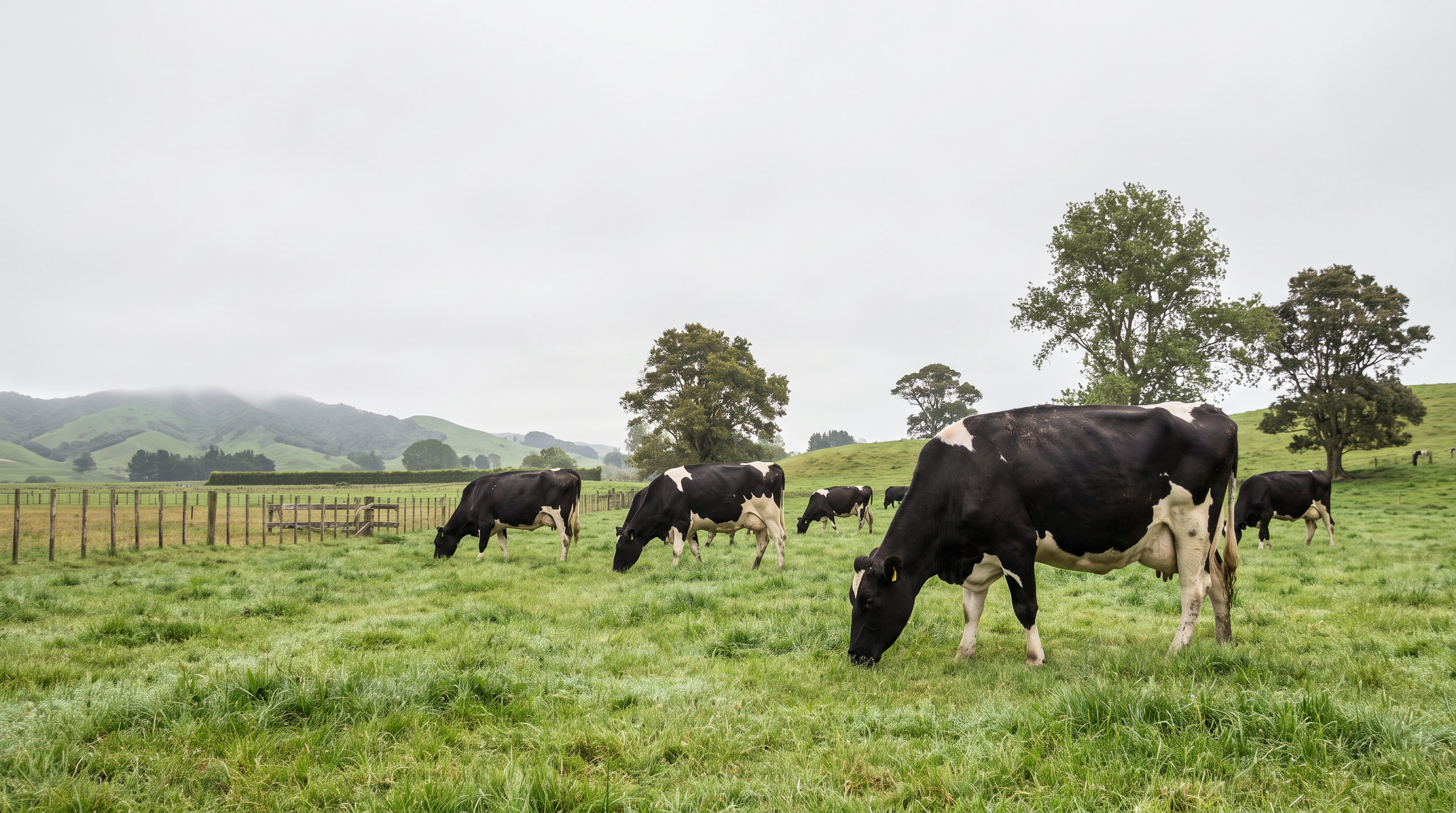
Could calving only half the herd each spring ease the busiest weeks on a dairy farm without sacrificing profit? DairyNZ's latest extended-lactation findings suggest it could work for some Friesian herds, but the feed budget and the cows themselves remain important qualifications.[1]
The 7 October update reports three years of farmlet results at Scott Farm in Waikato. In a system built around 24-month calving intervals, Friesian profitability ranged from 3% below to 4% above the conventional comparison, while milksolids production per hectare was higher. Farmers Weekly reported the findings on 9 October.[1][2]
What does a 24-month calving interval mean?
The trial compares cows calving annually in spring with a herd where approximately half are deliberately not mated each year. Those groups alternate, so roughly half the herd calves each spring. The interval describes time between calvings, not a guarantee that every cow milks continuously for two years.[3]
The idea is to reduce concentrated calving and mating pressure while retaining a pasture-based business. Fewer annual calvings also mean fewer non-replacement calves. DairyNZ links the work to its Dairy Beef Opportunities programme, which examines how dairy and beef systems can work together more effectively.[1]
How strong are the Friesian results?
The reported profit range is encouraging because it spans both sides of the conventional result rather than showing a large production gain bought at the expense of profit. It is still a result from a particular farmlet system, not a forecast for every Friesian herd or a promise of extra income.[1]
Higher milksolids per hectare is only part of the assessment. DairyNZ's study considers feed supply and demand alongside production. Its background material also makes clear that labour savings were not yet quantified in earlier comparisons: labour expenses were assumed equal between the farmlets. A quieter calving peak should not be read as a proven reduction in total annual labour cost.[3]
Where does the feed budget change?
Some cows continue milking through winter, when matching feed demand to pasture supply becomes particularly important. In the first winter of the study, the extended-lactation farmlet required an additional 180 kg of dry matter feed per cow. That is an earlier trial observation, not a universal allowance for farms adopting the system.[3]
Researchers then tried increasing autumn pasture cover and delaying calving to reduce supplementation. Extra supplements were still needed, while the later calving reduced days in milk, production and profit. The farmlet subsequently returned to the control group's calving date, with extra winter feed planned. Those adjustments show why the system needs a whole-farm feed calculation rather than a simple change to the mating calendar.[3]
Why is the Jersey picture less settled?
The first year of Jersey results showed substantial variation. Some cows stopped milking earlier than expected, while others continued much later. Nearly half of the extended-lactation Jerseys were still milking 60 days before planned calving. DairyNZ is monitoring a larger Jersey group and continuing regional modelling to understand which cows and conditions suit the approach.[1]
For farmers, the next useful evidence is not just another average production figure. It is how reliably different cows persist, what winter feeding costs, and what happens to workload on a commercial farm. A commercial pilot began in June 2025 to help examine farm-team effects that a farmlet cannot fully capture.[3]
What should farmers take from the update?
Extended lactation now has a stronger Friesian evidence base, but it remains an option to assess, not a blanket recommendation. Farmers interested in it can follow DairyNZ's project updates and discuss the feed, breeding and workload implications with their advisers before changing their system.
For DairyTech, this is useful context as calving patterns influence when farms manage colostrum and other non-saleable milk streams. Our waste-milk recovery work remains subject to prototype validation; the extended-lactation results do not establish the suitability or performance of our technology.