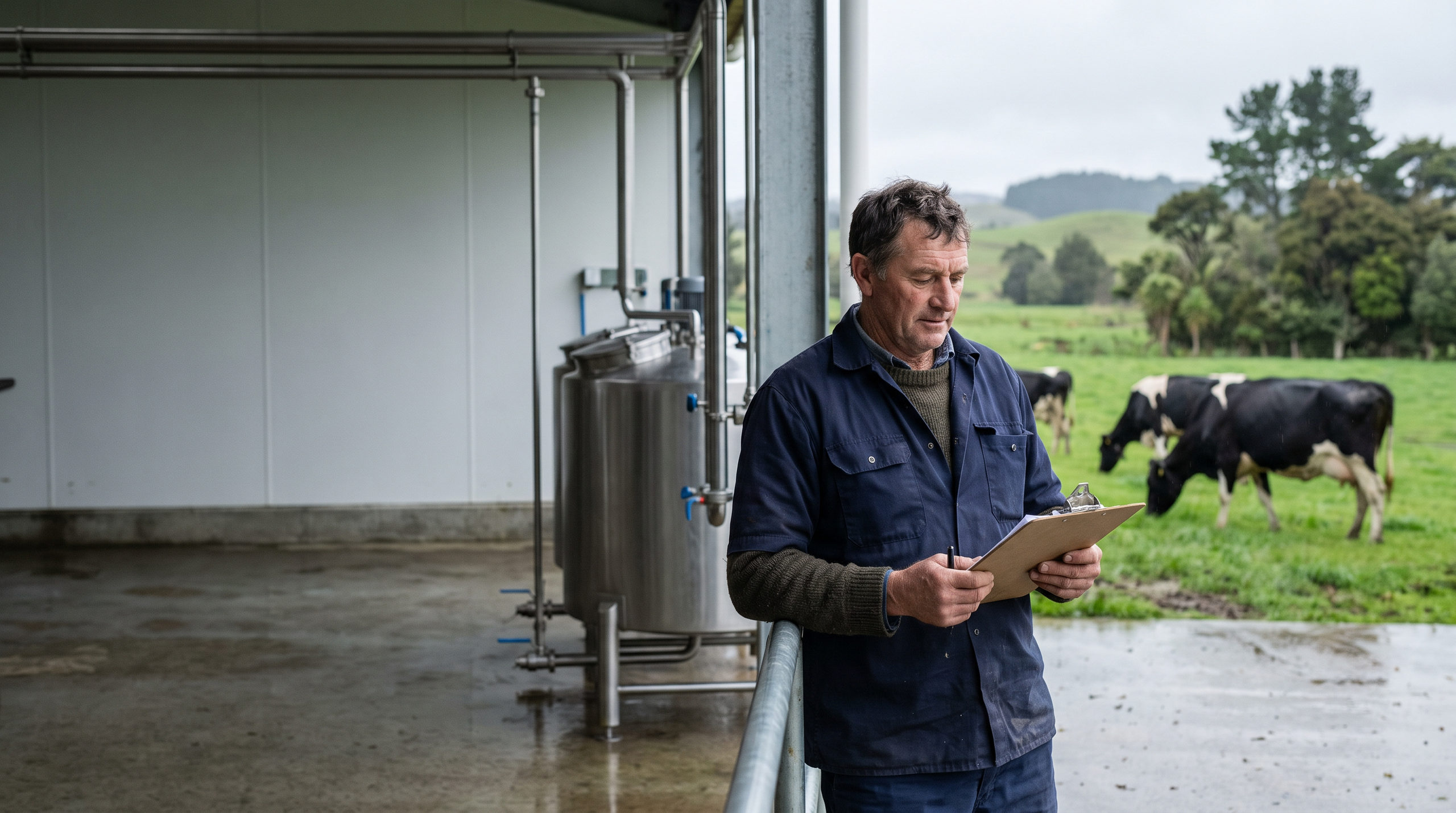
The dairy sector needs practical tools, not just policy targets. As New Zealand approaches the 2026 General Election, DairyNZ has outlined six clear priorities to support sector growth and give farmers the confidence to invest. The focus areas include resource management, freshwater, biosecurity, and science and innovation. The message is straightforward: farmers are willing to invest in productivity and environmental improvements, provided the policy settings are predictable and grounded in evidence.[1]
For any new on-farm technology, that means the burden of proof is high. It is not enough for a system to sound good in theory. It must fit within the strict compliance frameworks that govern how a New Zealand dairy farm operates every day.
Why compliance defines practical innovation
Farm dairy operators work under comprehensive legal obligations. The Animal Products Act 1999 and the Animal Products Regulations 2021 require every farm dairy to operate under a risk management programme (RMP). This covers the harvesting, filtering, cooling, and storage activities at the shed. In most cases, the dairy company receiving the milk is registered as the RMP operator, setting the baseline rules for food safety and supply conditions.[2]
This means any change to how milk is handled on farm must respect those boundaries. If a farm introduces new equipment to manage waste milk, that equipment cannot compromise the primary supply chain. It must be clear where the milk goes, how it is stored, and what the final product is used for.
How does MPI manage new technology?
The Ministry for Primary Industries (MPI) recognises that dairy systems are evolving. The Operational Code for the Design and Operation of Farm Dairies (NZCP1) includes provisions for alternative premises and equipment designs. This allows novel technologies to be assessed, even if they were not contemplated when the code was first written.[2]
However, the process is rigorous. MPI maintains a register of alternative designs. A novel technology might be listed provisionally to facilitate on-farm trials, or it might be placed on hold while further data is gathered. The ministry advises farmers to consult this register, along with their farm dairy assessor and dairy company representative, before committing to any new facilities or equipment.[2]
What this means for waste milk recovery
The drive to recover value from waste milk aligns strongly with DairyNZ's priorities for resource management and freshwater protection. Diverting high-nutrient waste milk away from effluent systems reduces environmental load and creates an opportunity to produce a stable, usable product on farm.
But the pathway to that outcome is defined by the regulatory framework. For a system like the AXIS drying unit, the goal is not to bypass the rules, but to work within them. The technology is currently in a prototype validation phase. The focus is on demonstrating that it can operate reliably, maintain separation from the primary milk supply, and produce a powder that meets the requirements of the Agricultural Compounds and Veterinary Medicines (ACVM) Act 1997 for animal feed-grade products.
The value of evidence-based investment
DairyNZ is right to highlight the link between certainty and investment. Farmers need to know that the tools they adopt will solve real problems without creating new compliance headaches. By engaging with the established MPI assessment pathways and focusing on measurable outcomes, the agritech sector can deliver the practical innovation that New Zealand dairy farms require.