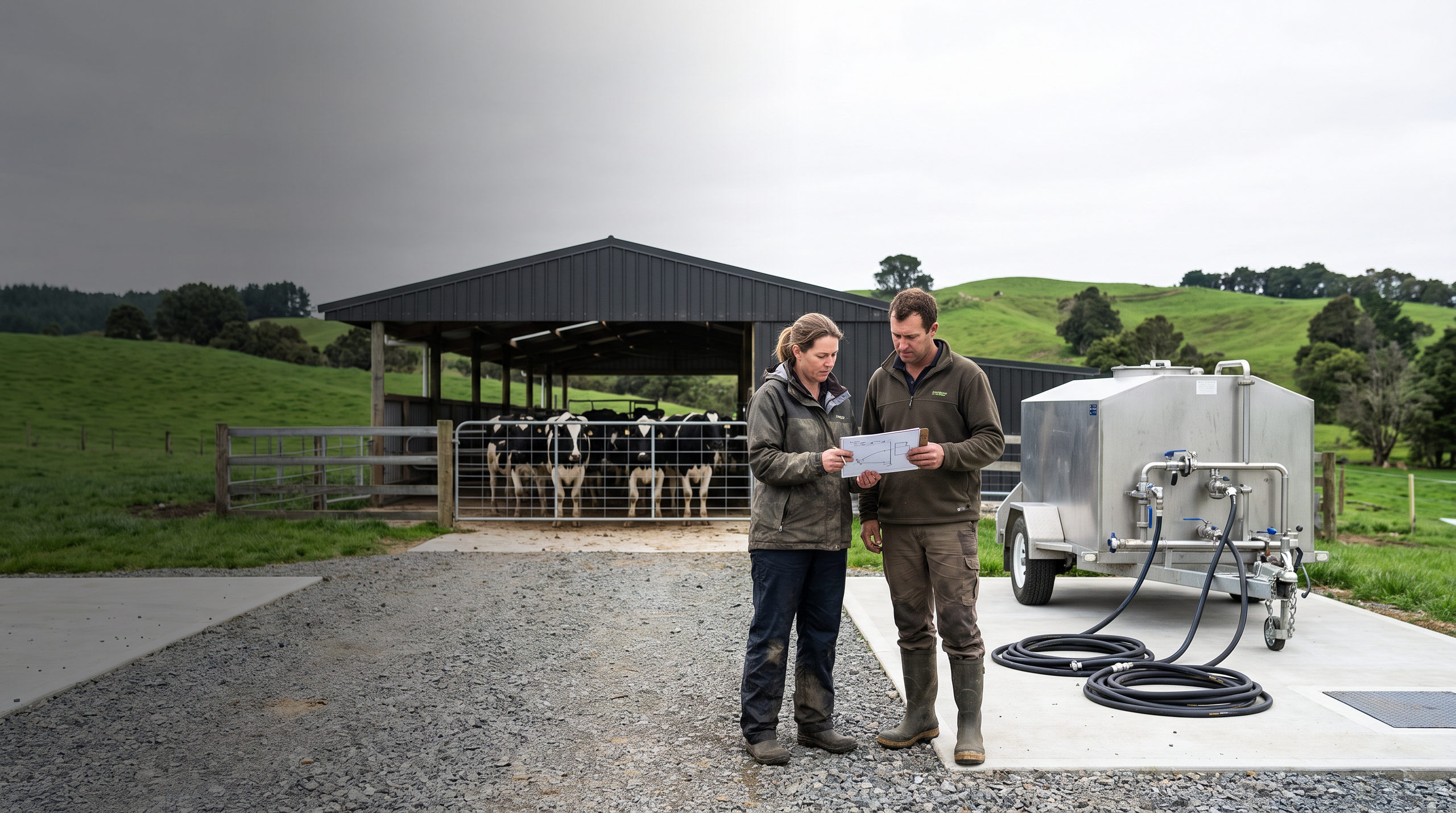
A first on-farm drying trial should not begin with a trailer delivery. It should begin with a shared understanding of what the trial is meant to answer. For DairyTech, the aim is to test whether a portable, on-farm process can handle suitable, separated milk streams in a way that fits real dairy operations. That requires a plan that protects the primary milk supply, gives the farm team a practical role and produces useful evidence.
The most valuable first trial is not necessarily the biggest. It is one with a clear boundary, an agreed purpose and a measurement plan that works on a busy farm. It should be designed with the farm's dairy company, assessor and other relevant advisers where appropriate. This is planning guidance, not a substitute for MPI, dairy-company, assessor, veterinary or health-and-safety advice.
Start by protecting the primary supply
Any trial concept needs a clear physical and operational separation from milk intended for the primary supply chain. MPI explains that farm dairy risk management programmes cover milk harvesting, filtering, cooling and storage. It also advises operators to consult their farm dairy assessor and dairy company representative before committing to a novel technology, premises, facilities, equipment or service design.[1]
For a trial, that means defining the boundary before discussing equipment detail. What stream is being considered? Why has it been diverted? Where is it held? Who can move it? What prevents it from being confused with milk intended for collection? The answers will be farm-specific, but they should be understood by everyone involved.
Write down the purpose in one plain sentence
A trial without a specific question can generate activity without generating a decision. A useful purpose might be: to assess whether a defined, separated stream can be handled within the farm's existing workflow while collecting data on time, access and operating conditions. That wording avoids assuming an outcome and keeps the task focused on evidence.
It also makes the discussion with advisers more productive. Instead of asking whether a new system will solve every waste-milk problem, the farm and development team can identify the exact operating question, the limits of the trial, and the information needed before any later decision.
Plan the location as a working route, not a display space
A credible trial site needs to work during a normal farm day. Walk the proposed location with the people who milk, manage effluent, move stock and maintain equipment. Map the route from the separated stream to the trial area, then consider where people, vehicles, cows, cleaning activity and existing services move through the same space.
The aim is not to prescribe a standard layout. It is to identify the constraints before the trial begins. A practical layout discussion can cover access, ground conditions, drainage, hose management, power and water requirements, wash-down expectations, visibility, traffic separation and the ability to return the area to normal farm use. The right answer depends on the farm dairy, its risk management programme and the guidance of the appropriate people.
Put operator input ahead of assumptions
Technology only earns its place on farm when it works for the people expected to use it. DairyNZ's Technology and Workplace Practices Survey found that farmers are investing in dairy-shed automation and animal-monitoring technology to support efficiency and management, while its research team emphasises working with farmers and technology developers to understand farm needs.[3]
Before a trial, ask the operators simple questions. At what point in milking could an extra task realistically happen? Where would the process create waiting, lifting or cleaning work? Which parts would be difficult in rain, darkness or peak calving pressure? What would make the trial easier to stop safely if a problem arose? Those details matter more than a tidy drawing made off farm.
Make safe access a condition of the trial
Introducing equipment changes a workplace. DairyNZ advises that farm-specific health and safety policies should identify the activities, equipment and site features that may cause harm. It also notes that risk-management practices should be reviewed when new machinery or chemicals are introduced, with the people doing the work involved in identifying risks and controls.[2]
For a trial, this should lead to a documented discussion of the actual work: arrival and positioning, traffic movements, connection and disconnection, wash-down, cleaning, maintenance, emergency stop arrangements, contractor access and the interfaces with animals and people. The farm's own health and safety processes, alongside competent advice, should determine the controls. A trial should not proceed simply because a site looks convenient.
Agree the measurements before the first run
Measurements should answer the written purpose, not create unnecessary paperwork. Depending on the scope agreed with the farm and advisers, the trial record may capture the reason a stream was diverted, approximate volume, timing, operator steps, energy or water use where relevant, cleaning time, interruptions, equipment observations and any deviations from the plan. The point is to make the operating reality visible.
Equally important is deciding what the trial will not claim to measure. A short operational trial cannot, by itself, establish broad product suitability, regulatory acceptance, nutrition, animal-health outcomes or commercial performance. Those questions require the relevant validation work and appropriate professional oversight.
Understand the validation boundary
MPI's farm dairy guidance recognises that novel technologies and alternative designs may need formal assessment. Its register can show whether a listing is provisional, on hold, approved or declined, and whether conditions or restrictions apply to a specified purpose.[1] A first trial should therefore be treated as evidence gathering within an agreed framework, not as a declaration that a new system is generally approved or ready for routine use.
AXIS is a DairyTech prototype under validation. The development programme is examining whether suitable, separated streams can be processed into a stable animal feed-grade powder, subject to final validation and applicable requirements. It does not assume that every diverted milk stream is appropriate, or that drying changes the source status, treatment history or obligations associated with that stream.
A practical first-trial checklist
- State the exact question the trial is intended to answer, and the boundaries it will respect.
- Confirm how the separated stream remains distinct from primary supply and who is responsible for each handover.
- Walk the proposed site with the farm team and relevant advisers before equipment is positioned.
- Record foreseeable safety, access, cleaning and contractor considerations through the farm's existing processes.
- Agree a short list of measurements, a record owner and a stop-and-review point before the first run.
The next step is a conversation, not a commitment. If your farm is exploring a controlled trial, DairyTech can begin with the practical operating questions and the appropriate validation pathways. That is the disciplined route to a portable, scalable and cost-effective system that solves a real waste-milk problem without creating a new one.