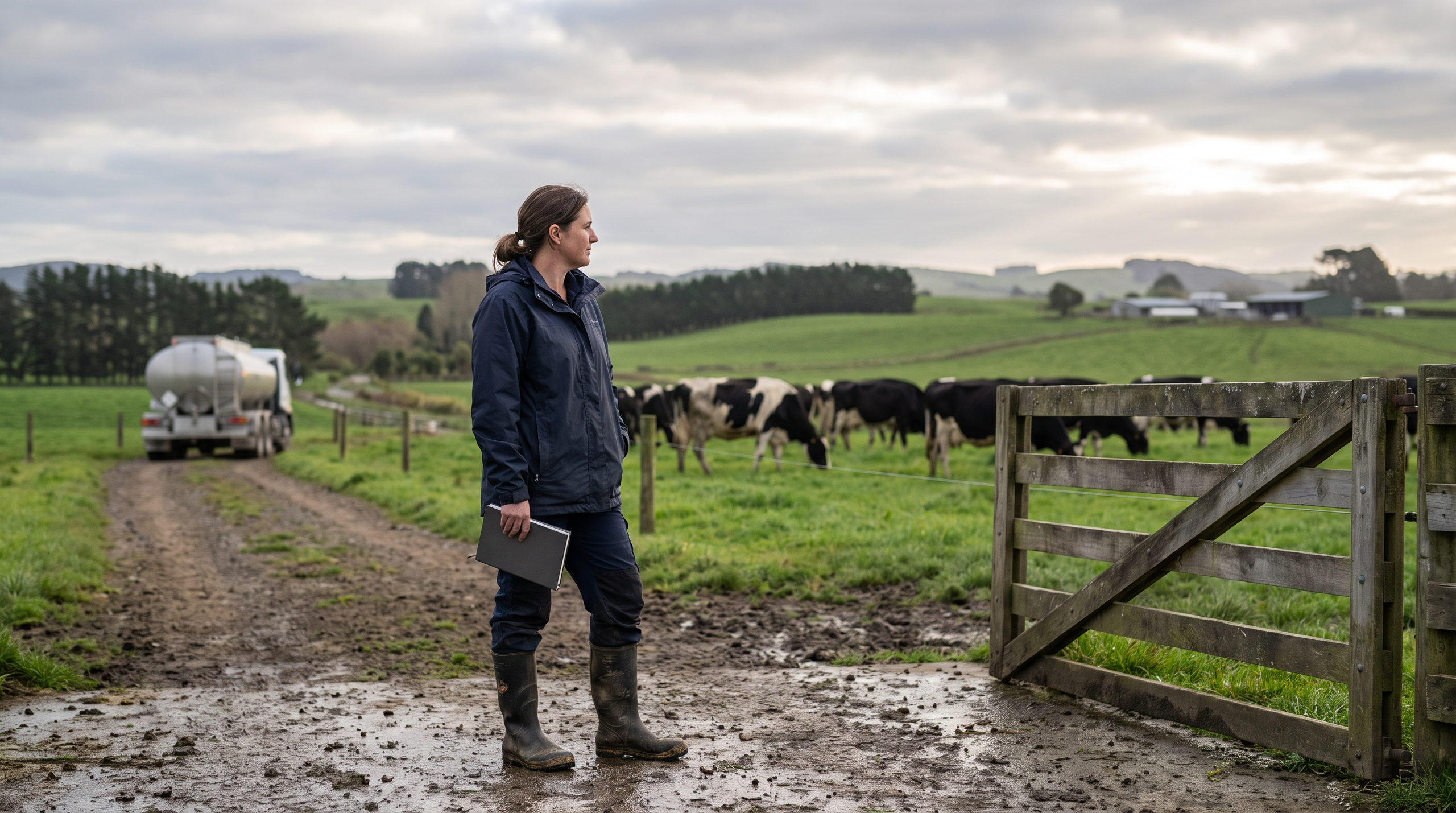
Fonterra's FY26 result gives New Zealand dairy a substantial end-of-season number to work with. The Co-operative reported $27 billion in revenue and $19.6 billion in total cash returns to New Zealand farmer owners and unit holders. It also confirmed a final 2025/26 Farmgate Milk Price of $9.69/kgMS.[1]
Those figures matter, but they are only part of the current picture. The result closes the 2025/26 year. The 2026/27 season is still taking shape, with a revised forecast, changing commodity markets and weather exposure all still in view.
First, separate the finished year from the next one
Fonterra reported fully imputed total FY26 dividends of 73 cents per share, including its final dividend and earlier payments. Its total Group operating profit was $3.4 billion and profit after tax was $2.6 billion.[1]
There is an important qualification inside that headline. Fonterra says the reported operating result includes a $1.2 billion benefit from the Mainland divestment. It separately reported underlying business operating profit of $1.8 billion for its continuing operations. That does not make the result less relevant. It simply means the headline profit should not be read as one recurring operating number.[1]
Second, the new-season forecast is still a forecast
On 21 September, Fonterra lifted the midpoint of its 2026/27 Farmgate Milk Price forecast from $9.25/kgMS to $9.50/kgMS. It also narrowed the range to $8.50 to $10.50/kgMS, pointing to recent improvements in whole and skim milk powder prices and continued global demand.[2]
The revision is a useful update, not a final payout. Fonterra itself said geopolitical volatility remains and that only two months of the season have passed. That is why the final FY26 milk price and the FY27 forecast should be kept in separate columns when the sector talks about the current outlook.
Third, the co-operative is putting capital behind protein capacity
Alongside the result, Fonterra announced an additional $1 billion of investment over three years in South Island protein manufacturing and environmental performance. The Co-operative says it wants to increase capacity, make greater use of capital retained from the Mainland sale and respond to demand for protein-rich dairy ingredients.[1]
For the wider sector, that is one of the more concrete parts of the announcement. It is a long-term processing and product-mix decision, rather than a short-term change to an individual farm's milk payment. Fonterra expects the projects to be operational in 2029 and estimates they will create around 50 to 60 permanent roles.[1]
What remains unresolved
Fonterra is forecasting milk collections just above 1.6 billion kgMS for 2026/27, while acknowledging an El Niño pattern may affect supply. Reuters also reported that weather is a meaningful downside risk for the volume available to process and sell if conditions become more severe.[1][3]
That is the useful restraint around a strong annual result. Dairy conditions are shaped by the combination of collection volumes, product mix, commodity prices, processing returns, input costs and weather. One result can be very good while the season ahead still has material uncertainty.
A small DairyTech context
For DairyTech, this is industry context rather than a claim about a product or solution. When the sector is discussing value, processing capacity and seasonal risk, routine on-farm losses are still worth making visible. A clear record of what is diverted, stored or disposed of helps a farm understand one part of its own operating picture without assuming a wider market outcome.